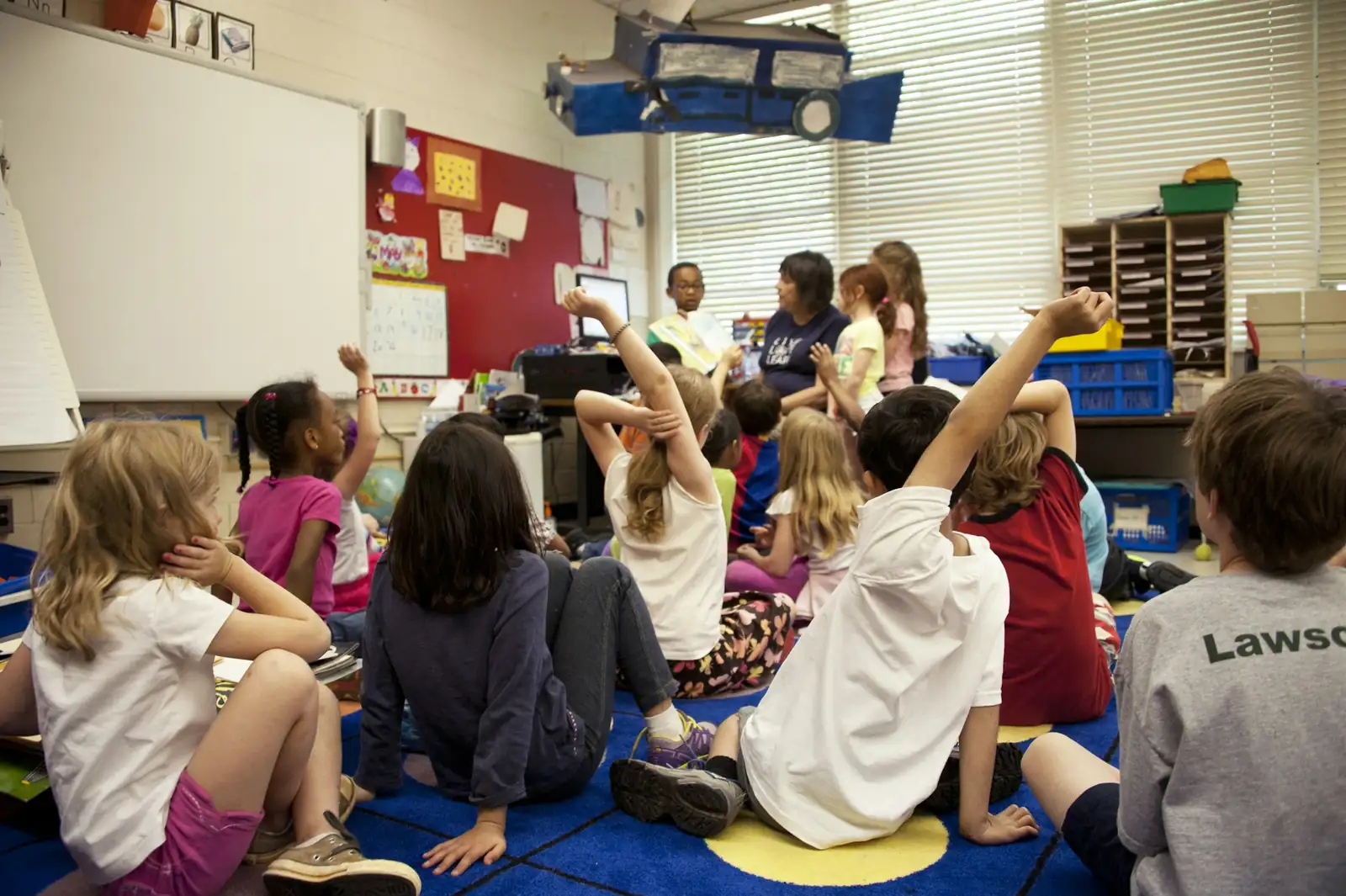



Feedback is specific and private first
Written or one-to-one feedback precedes public comment, so a student hears what to change before they hear it in front of peers.
About — Our Pedagogy
Our teaching is built around one problem. Schools are very good at measuring what students know, and far less equipped to develop how students communicate, reason and lead — particularly for the capable students in the middle of the class. Everything below exists to close that gap.
Skills-first, always applied, never abstract.
01
Communication, critical thinking, creativity and leadership are the syllabus — not a by-product of one. Topics are chosen to serve the skill, not the reverse.
02
Our educators bring real classroom experience from leading international and local schools, and are trained to a documented internal standard before they teach for us.
03
Every session includes structured practice, a real-world application and a reflection point. The sequence is fixed because the growth depends on it.
04
Programmes are tailored to the student, the school and the stated goal — including pace, grouping and the level of scaffolding.
05
Delivered in English, with Mandarin and Cantonese support so language never limits participation or hides a strong idea.
06
Every programme ends in a performance, a debate, a publication or a qualification. Never a certificate of attendance.
From framework to practice
Frameworks become meaningful only when students practise them. These are the three behaviours every Erudite Academy programme rehearses, whatever its subject.
Practice: speaking, storytelling, performance and publishing.
IB connection: Communicators · Risk-takers · Caring
Practice: debate, journalism, issue-based inquiry and crisis decision-making.
IB connection: Inquirers · Thinkers · Open-minded
Practice: feedback, redrafting, ethical communication and public-facing outcomes.
IB connection: Reflective · Principled · Balanced
Neither struggling nor exceptional, these students receive the least targeted development. They are capable, engaged and often overlooked. They rarely trigger urgent intervention, yet they are not always given the structured practice that helps confidence, communication and leadership grow.
Schools are built to respond to signals. A struggling student sends a signal. An exceptional student sends a signal. The student in the middle sends none at all.
The opportunity is not to lower the bar. It is to give more students a deliberate route towards it.
Exceptional
Gifted and talented streams, squads, competitions, showcases, leadership roles

The Invisible Middle
Attends. Participates when asked. Passes. Is rarely selected for anything.

Struggling
Learning support, intervention plans, close monitoring, extra staff time
No individual decision causes this. It is the cumulative effect of hundreds of reasonable ones.
A teacher with thirty students and finite hours must prioritise. The child who is coping gets less attention than the child who is not correctly, and consistently, for years.
Scaffolding the Invisible Middle is not a slogan for us. It is a set of specific design decisions in every session we run.
Written or one-to-one feedback precedes public comment, so a student hears what to change before they hear it in front of peers.

We report how far a student has moved from their own baseline — not where they rank in the group. The middle only stays invisible while the only measure is comparative.

Our programmes end in showcases, competitions, publications and examinations that include every participant — not a selected few representing the rest.

Speaking time is allocated structurally rather than competitively. No student can pass a session without having spoken, and no student can dominate one.

Chair, first speaker, rebuttal, summariser, note-taker. Every student cycles through every role, including the ones they would not have volunteered for.

Students rehearse in pairs, then small groups, then the full room, then an audience. Confidence is built in graduated increments, not demanded in one leap.
“Confidence is not a prerequisite for our classroom.
It is the outcome.”
A few signs, drawn from what parents most often describe to us. None of this indicates a problem to be fixed. It indicates capability that has not yet been given a structured route to visibility.

We can map this against your existing pastoral, character or learner-profile reporting. Ask us for the alignment document.

Our four pillars are deliberately legible to the frameworks your school already reports against.
| Pillar | What we develop | Where it lands |
|---|---|---|
| Communication | Clarity, delivery, audience awareness, active listening, voice and presence | Oral presentation and speaking-and-listening strands; IB Communicators |
| Critical Thinking | Argument construction, evidence handling, rebuttal, judgement under pressure | Enquiry, reasoning and evaluation criteria; IB Thinkers and Inquirers |
| Creativity | Original ideas, narrative craft, performance choices, redrafting | Creative and expressive arts outcomes; IB Risk-takers |
| Leadership | Chairing, collaboration, negotiation, initiative, responsibility | Character, service and leadership programmes; IB Principled and Caring |
Our programmes strengthen the human skills students need in order to communicate, collaborate and lead responsibly. We align to the five CASEL competencies and we teach them through performance, argument and publication rather than through worksheets.
SEL is not a separate add-on. It is embedded in every rehearsal, discussion, feedback cycle and final showcase.
Our founder’s Trinity specialism is teaching soft skills through drama, and that shapes the whole method. Drama, debate and performance create genuine emotional stakes in a controlled environment: a real audience, a real deadline, a real risk of getting it wrong — with a structure that makes failure survivable and useful.
That combination is difficult to manufacture in a classroom discussion and impossible in a worksheet. It is why we teach emotional intelligence by putting students in situations that require it, rather than by describing it to them.
A programme that only works for the confident child is not a programme worth running.

Sessions are structured so quieter students speak as often as louder ones. Participation is designed in, not hoped for.

We adapt pace, format and support for learners with additional needs. The standard itself stays where it is.

Mandarin and Cantonese support means an emerging English speaker can still make a strong argument.
We report how far a student has moved from their own starting point, not where they sit against the group.
“Confidence is not a prerequisite for our classroom. It is the outcome.”
Soft skills can be assessed rigorously. They simply cannot be assessed with a percentage.
In session one, every student gives a short recorded or observed contribution against a fixed rubric. This is their reference point, not a rank.
We focus on the human skills that matter most in an AI-dominated world — the ability to communicate with precision, think independently, create something original and lead other people. As technology absorbs more of the technical work, these are the skills that decide who is listened to, trusted and followed.
We are deliberately narrow. We would rather run ten programmes properly than fifty badly, and we would rather be the best in Hong Kong at one category of work than adequate across six.